High-Fiber Foods With Resistant Starch: What to Eat and Why
Discover high-fiber foods with resistant starch, how cooking and cooling affect starch, and simple ways to add more fiber to everyday meals.
By MetabolicFoods Editorial Team
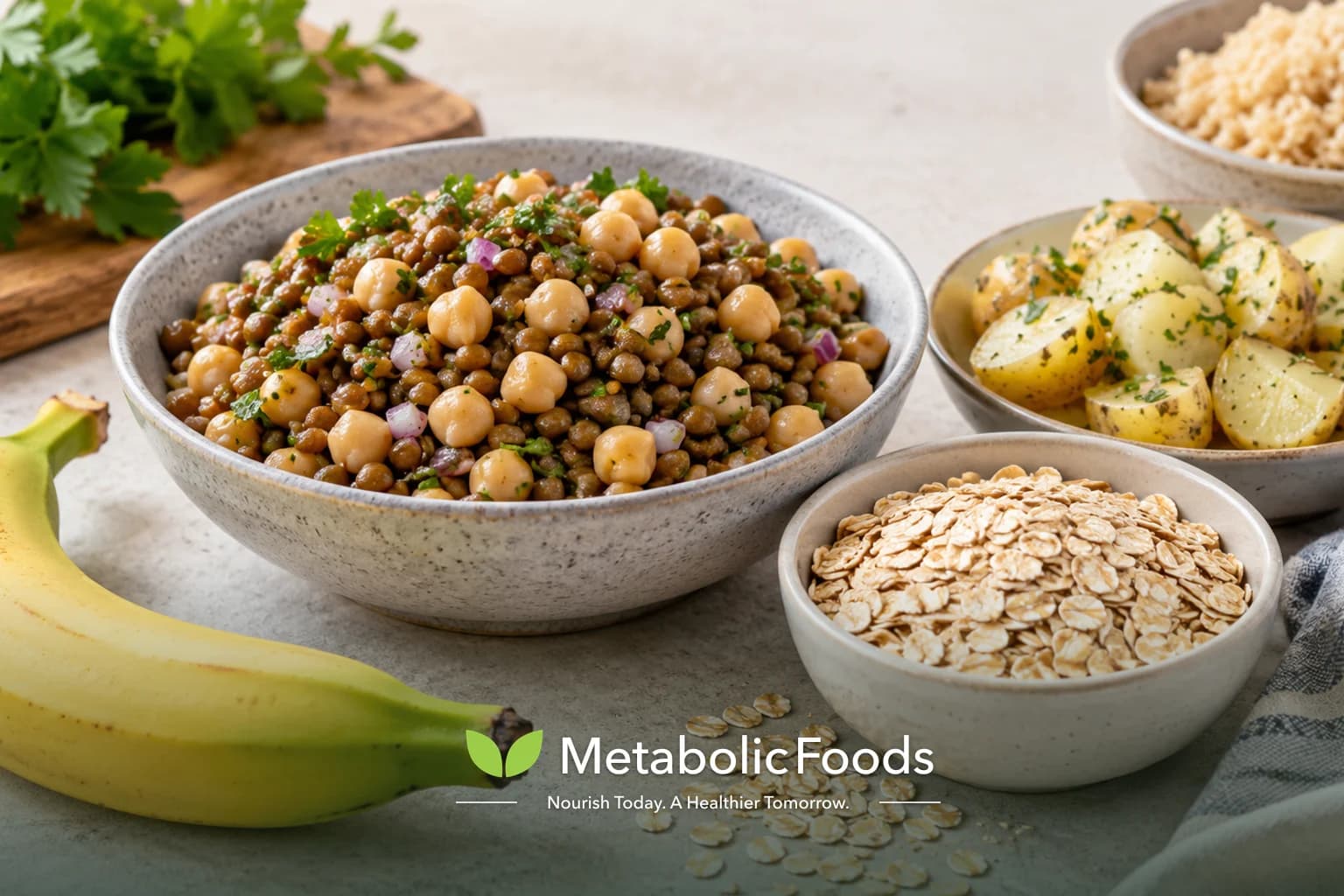
A bowl of lentils, a chilled potato salad, or a slightly underripe banana can add more than variety to your meals. These foods can provide resistant starch, a type of carbohydrate that is not fully digested in the small intestine.
Instead, some resistant starch reaches the large intestine, where gut microbes can ferment it. That makes it different from rapidly digested starches and one reason it is often discussed alongside fiber and gut health.
For everyday eating, the goal is not to chase resistant starch as a single "super nutrient." A better approach is to build meals around foods that also provide fiber, protein, vitamins, minerals, and satisfying texture.
What Is Resistant Starch?
Most digestible starch is broken down into glucose in the small intestine.
Resistant starch behaves differently. At least part of it resists digestion and reaches the colon, where gut bacteria can ferment it and produce short-chain fatty acids, including butyrate.
Butyrate is one of several compounds produced by gut microbes and is a preferred energy source for the cells lining the colon.
Resistant starch may also influence how quickly some carbohydrate-containing foods affect blood sugar, although the response varies depending on the food, portion size, preparation method, meal composition, and the individual.
Resistant starch is often discussed alongside prebiotic fiber because both can interact with the gut microbiome. Our article Prebiotics vs. Probiotics explains how those terms are defined.
Resistant starch is often grouped with dietary fiber because both reach the large intestine and can be fermented there, but the two are not the same thing.
A food can contain resistant starch without being especially high in fiber. A less-ripe banana is one example: in a classic study, the banana starch that reached the large intestine was up to eight times the amount of fiber in the same fruit, depending on how ripe it was.
For most people, the most practical choice is to prioritize foods that contribute both.
If you want to understand daily fiber needs in more detail, see our guide How Much Fiber Do You Really Need?
High-Fiber Foods With Resistant Starch Worth Eating
Beans, Lentils, and Chickpeas
Legumes are one of the easiest places to start.
Foods such as these provide dietary fiber, plant protein, and naturally occurring resistant starch: • Black beans • Kidney beans • Chickpeas • Lentils • Navy beans • Pinto beans
They also work well in everyday meals such as soups, salads, tacos, grain bowls, and stews.
Canned beans are a perfectly practical option. Choose lower-sodium varieties when available, or drain and rinse regular canned beans before eating, which can cut their sodium noticeably.
Cooling cooked legumes may slightly change their starch structure, but there is no need to over-optimize every meal. Eating legumes regularly is more important than trying to maximize resistant starch in every serving.
Oats and Barley
Oats and barley are useful choices because they contribute fiber along with starch.
Both are notable sources of beta-glucan, a soluble fiber found in some whole grains.
Oats can work well in: • Overnight oats • Hot oatmeal • Yogurt bowls • Homemade granola • High-fiber breakfast recipes
Choose plain oats when possible and add flavor with fruit, cinnamon, nuts, seeds, or nut butter instead of relying on heavily sweetened instant products.
Slightly Underripe Bananas and Plantains
Bananas change as they ripen.
A firmer, slightly underripe banana generally contains more resistant starch than a very ripe banana because much of the starch converts to sugars during ripening.
That does not make ripe bananas unhealthy. It simply means that a less-ripe banana may be a better choice when resistant starch is specifically your goal.
Slightly underripe bananas can be added to: • Yogurt • Smoothies • Oatmeal • Nut-butter snacks
Plantains are another option. They are usually cooked before eating and can work well baked, boiled, or roasted as part of a balanced meal.
Cooked and Cooled Potatoes, Rice, and Pasta
Cooking and then cooling certain starch-rich foods can change part of their starch structure through a process called retrogradation.
As the food cools, some starch becomes less available for digestion and can behave more like resistant starch.
Examples include: • Cooked and cooled potatoes • Chilled rice • Pasta salad • Grain bowls made with previously cooked grains
This does not automatically turn white rice, potatoes, or pasta into high-fiber foods.
Their resistant starch content may increase after cooling, but legumes, vegetables, whole grains, seeds, and other fiber-rich foods should still provide most of the fiber in your meal.
A more balanced example would be cooled brown rice with black beans, vegetables, and avocado, rather than a large bowl of cooled rice by itself.
Does Reheating Remove Resistant Starch?
Not necessarily.
Some resistant starch formed during cooling can remain after reheating. In one small study, white rice that was cooked, refrigerated for 24 hours, and then reheated still had more than double the resistant starch of freshly cooked rice.
That means cooking food in advance, refrigerating it, and reheating it later can still fit into a resistant-starch-friendly eating pattern.
Food safety matters, however.
The USDA advises refrigerating leftovers within 2 hours of cooking and reheating them until they reach 165°F (74°C), measured with a food thermometer.
Build Meals Around the Whole Food, Not One Nutrient
Resistant starch is useful, but it should not become the only thing you look for.
A better meal-building strategy is to combine a high-fiber or resistant-starch food with: • A protein source • Nonstarchy vegetables • A healthy fat • Other whole or minimally processed foods
For example: salmon, barley, white beans, arugula, olive oil, and lemon.
Or: chickpeas, cooled roasted potatoes, chopped vegetables, and a yogurt dressing.
If you want a practical framework for building meals with a steadier glycemic profile, see our guide How to Build a Lower-Glycemic Meal.
These combinations provide more nutritional value than focusing only on starch type.
High-Fiber Breakfast Ideas With Resistant Starch
Breakfast is another easy place to increase fiber. Try combinations such as these.
Overnight Oats With Berries
Use: • Plain oats • Greek yogurt or soy yogurt • Chia seeds • Berries • Nuts
Oatmeal With Seeds and Fruit
Combine oats with: • Ground flaxseed • Pumpkin seeds • Cinnamon • Blueberries • Nut butter
Yogurt With a Slightly Underripe Banana
Pair plain Greek yogurt or an unsweetened plant-based yogurt with: • Slightly underripe banana • Walnuts • Chia seeds • Cinnamon
The goal is not to eliminate carbohydrates. It is to choose carbohydrate foods that also bring fiber, protein, and other nutrients to the meal.
How to Add More Resistant Starch Without Making Food Complicated
You do not need special supplements or unusual recipes.
Simple habits can help: • Keep canned beans in the pantry • Cook extra lentils for several meals • Prepare oats overnight • Cook extra potatoes or grains for tomorrow's lunch • Use beans in salads and grain bowls • Choose less-processed whole grains more often
At the grocery store, look for foods in recognizable forms rather than relying only on front-of-package claims.
The Nutrition Facts label and ingredient list can help you compare packaged foods, especially for dietary fiber, added sugars, sodium, and serving size.
Increase Fiber Gradually
If your current diet is low in fiber, adding a large amount in a short time can cause: • Gas • Bloating • Abdominal cramps
Increase high-fiber foods gradually instead, over a period of a few weeks.
For example, start by adding: • Half a cup of beans to one meal • Oats a few mornings per week • One extra serving of vegetables • A small portion of lentils or barley
Drinking enough fluids also helps, since water helps fiber move through the digestive system.
People with ongoing digestive symptoms, a history of intestinal narrowing, or a medically prescribed diet should discuss major dietary changes with a qualified healthcare professional.
The Bottom Line
Resistant starch can be a useful part of a high-fiber eating pattern, but it is not a shortcut to better metabolic health.
The strongest choices are foods that bring several benefits at once.
Beans, lentils, oats, barley, slightly underripe bananas, and cooked-and-cooled starches can all fit into a balanced diet.
Instead of trying to maximize resistant starch in every meal, focus on repeatable habits: • Eat more legumes • Choose whole grains • Build meals with protein and vegetables • Increase fiber gradually • Use simple food preparation methods you can maintain long term
The best strategy is the one that improves the overall quality of your diet and is realistic enough to repeat.
Sources
- Effect of cooling of cooked white rice on resistant starch content and glycemic responseAsia Pacific Journal of Clinical NutritionJanuary 1, 2015Verified
- Leftovers and Food SafetyUSDA Food Safety and Inspection ServiceVerified
- New definition of resistant starch types from the gut microbiota perspectives - a reviewCritical Reviews in Food Science and NutritionJanuary 25, 2022Verified
- 21 CFR 101.81 — Health claims: Soluble fiber from certain foods and risk of coronary heart diseaseU.S. Food and Drug Administration (Code of Federal Regulations)Verified
- Short-chain fatty acids and human colonic function: roles of resistant starch and nonstarch polysaccharidesPhysiological ReviewsJuly 1, 2001Verified
- How to Understand and Use the Nutrition Facts LabelU.S. Food and Drug AdministrationVerified
- A comparison of the effects of resistant starch types on glycemic response in individuals with type 2 diabetes or prediabetes: A systematic review and meta-analysisFrontiers in NutritionMarch 27, 2023Verified
- Fiber (MedlinePlus Medical Encyclopedia)MedlinePlus, U.S. National Library of MedicineVerified
- How to Reduce Sodium in Your DietAmerican Heart AssociationVerified
- Legumes and PulsesHarvard T.H. Chan School of Public Health, The Nutrition SourceVerified
- Digestion of the carbohydrates of banana (Musa paradisiaca sapientum) in the human small intestineAmerican Journal of Clinical NutritionJuly 1, 1986Verified
Continue reading

What Is Resistant Starch? Foods, Benefits, and How It Works
Resistant starch is the portion of starch that skips digestion in the small intestine. Here is how it is classified, what the research links to it, and where it shows up in ordinary food.
Soluble vs. Insoluble Fiber: What's the Difference?
Fiber is often discussed as two broad types. Here is what soluble and insoluble actually describe, what current research links to each, and why the field has moved past a simple binary.

How Much Fiber Do You Really Need?
Fiber is recommended everywhere and explained almost nowhere. Here is what a major 2019 review found, what "association" really means, and how two ordinary meals get you most of the way.