How Much Fiber Do You Really Need?
Fiber is recommended everywhere and explained almost nowhere. Here is what a major 2019 review found, what "association" really means, and how two ordinary meals get you most of the way.
By MetabolicFoods Editorial Team
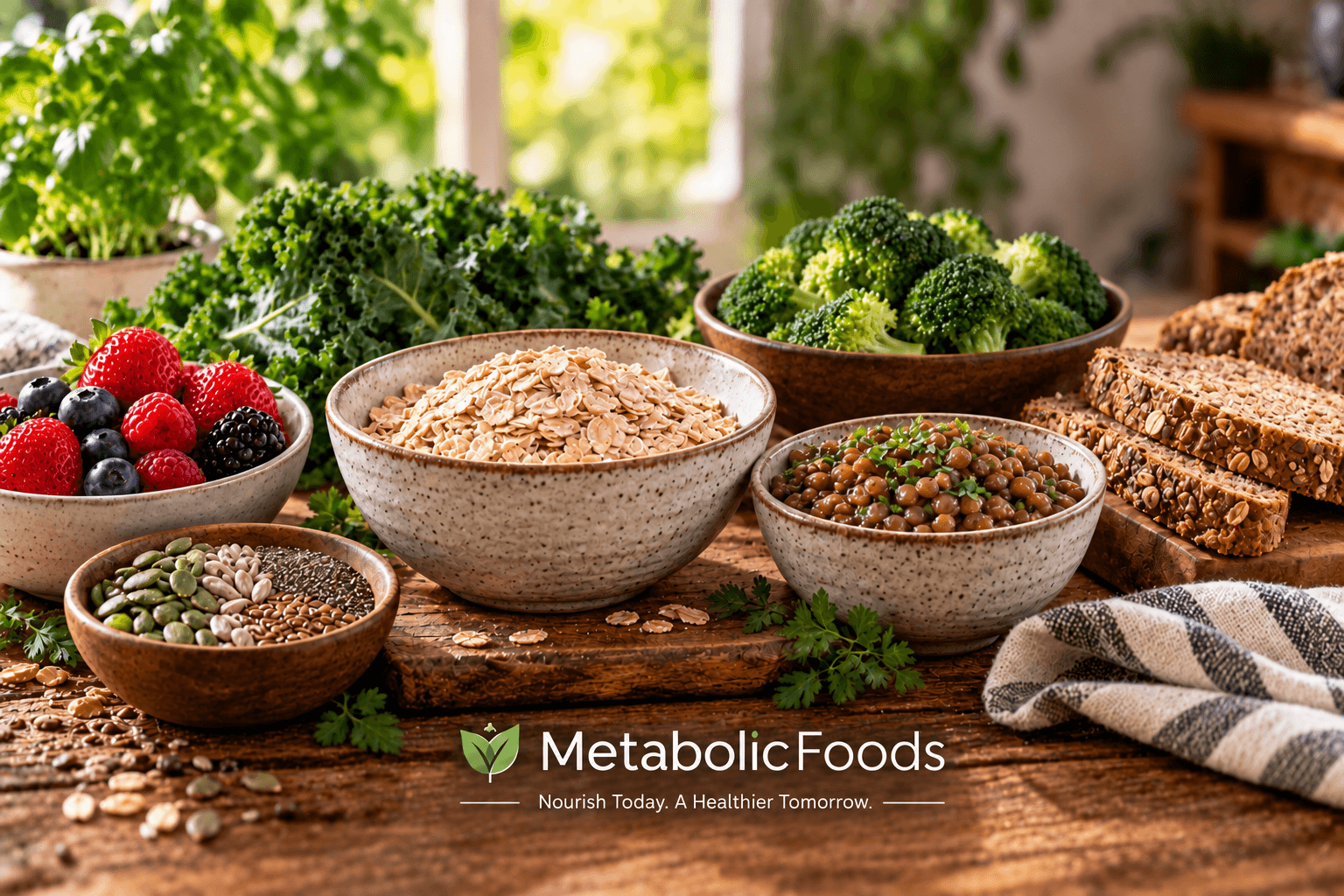
Few nutrients are talked about as often, and understood as little, as fiber. It appears on packaging, in headlines, and in the advice of nearly everyone with an opinion about eating well. Yet ask most people how much they need, or what the evidence actually says, and the conversation tends to trail off. This article is an attempt to fill that gap plainly, without hype, and with the sources shown.
What the evidence looks like
The most useful starting point is a 2019 review published in The Lancet by Reynolds and colleagues. Rather than a single study, it is a systematic review and meta-analysis: the authors gathered the existing research on carbohydrate quality and health, assessed it, and pooled the results. Work of this kind sits near the top of the evidence hierarchy because it summarizes many studies rather than relying on one.
The review drew on two kinds of research, and the distinction matters. Observational studies follow large groups of people over time and look for patterns between what they eat and what happens to their health. They can show that two things tend to occur together; they cannot, on their own, prove that one causes the other. Randomized controlled trials assign people to different diets and measure the outcomes directly. They can speak more directly to cause and effect, but they are usually shorter and smaller.
What the observational research found
Comparing the people who ate the most fiber with those who ate the least, the observational studies in the review found associations with lower rates of all-cause mortality, cardiovascular mortality, coronary heart disease, stroke, type 2 diabetes, and colorectal cancer.
It is worth pausing on the word "associations." The people eating the most fiber were, in these studies, less likely to experience these outcomes. That is a consistent and meaningful pattern, but it is not the same as showing that fiber alone was responsible. People who eat more fiber may differ in many other ways. A pattern this broad and this consistent is a strong reason to take fiber seriously; it is not a promise about any individual.
What the trials found
The randomized trials in the same review point in the same direction, on a shorter timescale and with more modest effects. Higher fiber intake in those trials was linked to modest reductions in body weight, blood pressure, and total cholesterol.
"Modest" is the right word. These are measurable shifts, not transformations. Taken together with the observational data, though, they help explain the attention fiber receives: the evidence comes from more than one direction.
Where the numbers come from
Perhaps the most practical finding in the review concerns quantity. The greatest reductions in risk were associated with daily fiber intakes of roughly 25 to 29 grams. This is the origin of a range you may have seen quoted elsewhere, and it is helpful to know that it comes from a synthesis of the research rather than from a rule of thumb.
Two caveats belong alongside that figure. First, it describes where the strongest associations were observed across populations; it is not a threshold below which nothing happens or above which nothing improves. Second, it comes from observational data, with all the limits described above. It is a well-supported target, not a prescription.
Turning a number into meals
What the research does not do is tell you how to eat. That part is practical, and it is where a food-first approach helps.
A useful habit is to think in terms of whole meals rather than individual "high-fiber" ingredients. Our High-Fiber Lentil & Greens Bowl, for example, provides about 9 grams of fiber per serving, calculated from USDA FoodData Central data for its listed ingredients. Our Berry & Chia Overnight Oats comes to about 10 grams per serving by the same method. Two meals like these account for a substantial share of the 25-to-29-gram range on their own, which is a more encouraging way to look at the target than counting grams at every snack.
Those figures are estimates. They are calculated from listed ingredients and will vary with brands, preparation, and substitutions, which is the same caution we print beside every nutrition panel on this site.
Reading fiber claims elsewhere
Because fiber has a good reputation, it is often used as a selling point. A calm way to evaluate any claim is to ask what kind of evidence sits behind it. Is it a pattern observed across a population, a result from a controlled trial, or simply a statement on a package? The research described here supports the general case for eating more fiber from food. It does not support the idea that any single product or ingredient is special.
What this article leaves out
A few things have been deliberately left aside, and it is fairer to say so than to gloss over them. This article does not explain how fiber behaves in the body, and it does not offer a ranked list of fiber-rich foods with figures attached. Both are reasonable questions; both deserve their own properly sourced treatment rather than a quick summary from memory. Where we do give numbers, they are calculated from USDA data for a specific recipe, and they are labeled as estimates. That restraint is intentional. It is easier to trust a site that says less and shows its sources than one that says everything and shows none.
The short version
Higher fiber intake is associated, in a large body of observational research, with lower rates of several serious outcomes, and controlled trials link it to modest improvements in weight, blood pressure, and cholesterol. The strongest associations were seen at intakes of roughly 25 to 29 grams a day. None of this makes fiber a cure for anything; it makes it a well-supported part of an ordinary, good diet. If you want somewhere to begin, the High Fiber category on this site gathers the recipes and foods that fit, each with a nutrition panel you can check.
Sources
- Carbohydrate quality and human health: a series of systematic reviews and meta-analysesThe LancetJanuary 10, 2019Verified
- USDA FoodData CentralU.S. Department of AgricultureVerified
Continue reading
What Is Resistant Starch? Foods, Benefits, and How It Works
Resistant starch is the portion of starch that skips digestion in the small intestine. Here is how it is classified, what the research links to it, and where it shows up in ordinary food.
Soluble vs. Insoluble Fiber: What's the Difference?
Fiber is often discussed as two broad types. Here is what soluble and insoluble actually describe, what current research links to each, and why the field has moved past a simple binary.
How to Build a Lower-Glycemic Meal
Glycemic index describes individual foods. Here is what the research says about how combining and sequencing foods within a meal changes the outcome.