Best Fiber Supplement: How to Choose the Right Type
The best fiber supplement depends on your goal. Compare psyllium, methylcellulose, wheat dextrin, inulin, and PHGG for evidence, tolerance, and safety.
By MetabolicFoods Editorial Team
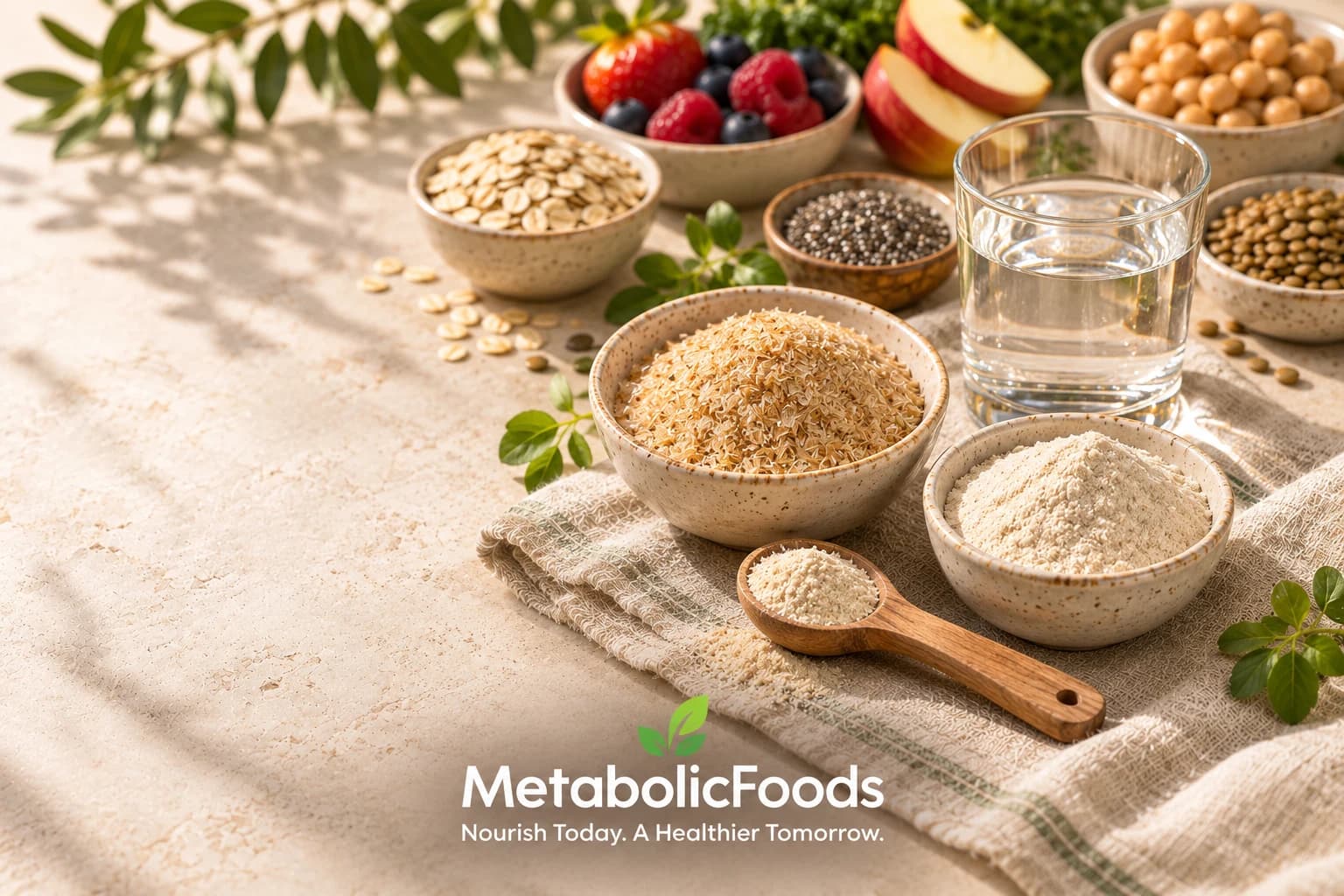
What is the best fiber supplement? There is no single winner for every goal, but psyllium has the strongest direct evidence among commonly sold fiber supplements for improving chronic constipation. It also has evidence for lowering LDL cholesterol when used in the studied amounts and dietary context. The tradeoffs are its thick texture, need for adequate liquid, and choking risk for people with swallowing problems.
Other fibers may be easier to mix or better tolerated by a particular person, but “dissolves clearly,” “prebiotic,” and “plant based” do not mean they produce the same clinical effect as psyllium. Start with the outcome you want, then compare the specific fiber, amount per daily serving, safety directions, added ingredients, and quality verification.
Decide What You Want the Supplement to Do
Fiber is not one substance. Different fibers vary in viscosity, fermentability, water-holding ability, and resistance to digestion. Those properties help explain why one product can form a gel, another can be fermented rapidly by gut microbes, and another can disappear into coffee without noticeably changing the texture.
Before shopping, identify the main goal:
- Constipation or irregular hard stools: psyllium has the best direct evidence among the commonly studied supplements.
- A clear-mixing product: wheat dextrin or partially hydrolyzed guar gum may be easier to use, but convenience is not proof of an equal laxative effect.
- A less-fermentable option: methylcellulose may appeal to someone who notices gas with fermentable fibers, although the clinical evidence base is smaller than it is for psyllium.
- A prebiotic ingredient: inulin-type fructans can change specific gut bacteria, but they can also increase flatulence and should not be assumed to treat constipation.
- Closing a general intake gap: the amount of fiber you will actually take, the product's ingredients, and your food pattern matter more than a marketing superlative.
If the goal is persistent constipation, unexplained diarrhea, abdominal pain, rectal bleeding, or another ongoing symptom, choosing a supplement is not the same as identifying the cause. Those situations deserve clinical evaluation rather than repeated product switching.
Psyllium: The Best-Supported Starting Point for Constipation
Psyllium husk is a soluble, viscous, gel-forming fiber. It absorbs water and remains sufficiently intact through the large bowel to change stool water and form.
A 2022 systematic review and meta-analysis of randomized trials in adults with chronic constipation found that fiber supplementation improved several outcomes, with psyllium showing the clearest benefit among the fibers studied. The 2023 joint guideline from the American Gastroenterological Association and American College of Gastroenterology conditionally suggests fiber supplementation for chronic idiopathic constipation; the guideline notes that psyllium appeared effective, while evidence for several other fibers was limited.
Psyllium also has a specific FDA-authorized health-claim pathway. Qualifying foods can state that soluble fiber from psyllium, as part of a diet low in saturated fat and cholesterol, may reduce heart-disease risk. That is a tightly defined labeling claim—not proof that every psyllium product or dose will produce the same result, and not a replacement for prescribed cholesterol treatment.
Psyllium Safety Is Not Optional
Psyllium powder or granules must be taken with adequate liquid. MedlinePlus directs users to mix a dose with at least 8 ounces, or 240 milliliters, of liquid and take it promptly. Dry or incompletely hydrated psyllium can swell and obstruct the throat or esophagus.
Do not use a dry psyllium product if you have difficulty swallowing unless a qualified clinician specifically advises it. Ask before use if you have a history of intestinal blockage or narrowing. Chest pain, vomiting, or difficulty swallowing or breathing after a dose requires immediate medical attention.
How the Other Common Fibers Compare
Methylcellulose
Methylcellulose is a semisynthetic bulk-forming fiber that is less fermentable than inulin-type fibers. That makes it a reasonable product to discuss with a pharmacist or clinician when gas is a major concern.
Its limitation is evidence. Methylcellulose is widely sold and included in clinical discussions of bulk-forming agents, but the 2023 constipation guideline did not identify the same direct evidence of benefit that it found for psyllium. Choose it for a practical reason—such as texture or tolerance—not because the category name proves equal effectiveness.
Methylcellulose products still require attention to liquid and choking warnings. Follow the exact label rather than assuming a nonfermentable fiber can be swallowed dry.
Wheat Dextrin
Wheat dextrin is a soluble, nonviscous fiber that can dissolve with little change in texture. That can make it convenient in beverages or soft foods.
Clear mixing is the main practical advantage; it is not evidence that the product will have the same stool-normalizing or cholesterol-lowering effects as a gel-forming fiber. The ingredient is also not the same as intact wheat bran. If you have celiac disease, wheat allergy, or another reason to avoid wheat-derived ingredients, verify the exact product's gluten and allergen labeling rather than relying on a general statement about processing.
Inulin and Chicory-Root Fiber
Inulin-type fructans are fermentable fibers used in powders, bars, gummies, and fiber-fortified foods. Human trials support their prebiotic potential, meaning specific compounds can be selectively used by gut microorganisms and produce a demonstrated benefit under the studied conditions. “Prebiotic” does not mean every dose or product has the same effect.
Inulin is not the best default choice for constipation. A recent evidence-based dietetic guideline found that inulin-type fructan supplements increased flatulence severity in adults with chronic constipation. If fiber-fortified bars or powders tend to make you uncomfortable, check the ingredient list for inulin, chicory-root fiber, fructooligosaccharides, or oligofructose.
Read more about what the term does—and does not—mean in our guide to prebiotic fiber.
Partially Hydrolyzed Guar Gum
Partially hydrolyzed guar gum, or PHGG, is a soluble, fermentable fiber that generally mixes without forming the thick gel associated with psyllium. Small clinical studies have examined it for bowel symptoms, but the evidence is not strong enough to call it universally gentler or more effective.
PHGG may be a reasonable alternative when mixability is the deciding factor. Judge the actual product by its daily fiber amount, ingredient list, tolerance, and cost—not by the word “guar” alone, because partially hydrolyzed guar gum behaves differently from intact guar gum.
A Quick Comparison
| Fiber | Practical strength | Evidence limit or tradeoff | | --- | --- | --- | | Psyllium | Best direct evidence here for chronic constipation; gel-forming | Thick texture; must be taken with adequate liquid; not suitable for swallowing difficulty | | Methylcellulose | Less fermentable; bulk-forming | Less direct trial evidence than psyllium; still requires label-directed liquid | | Wheat dextrin | Clear mixing and mild texture | Nonviscous; convenience does not prove equal laxative or metabolic effects | | Inulin/chicory root | Prebiotic potential | Can increase flatulence; not a default constipation treatment | | PHGG | Mixes easily; some clinical research | Smaller and more product-specific evidence base |
This table compares fiber types, not brands. Formulation, dose, flavoring, sweeteners, and instructions can differ even when the front labels use similar language.
Read the Correct Label Panel
Not every fiber product is regulated or labeled in the same way. A dietary supplement generally carries a Supplement Facts panel. A bulk-forming laxative sold as an over-the-counter drug carries Drug Facts. Some fiber-fortified foods use Nutrition Facts.
Use the panel that is actually on the package and check:
1. The named active or dietary fiber: “fiber blend” is less informative than a specific ingredient. 2. Fiber per serving: compare this with the serving you will realistically take. 3. Servings per day: a headline amount may assume multiple doses. 4. Added ingredients: sugar, sugar alcohols, inulin, flavors, colors, sodium, and sweeteners may affect fit or tolerance. 5. Directions and warnings: especially liquid requirements, age limits, duration of use, allergy statements, and when to contact a clinician. 6. Cost per daily amount: a low tub price can hide a small serving or many required capsules.
FDA does not approve dietary supplements for safety and effectiveness before they are marketed. A legitimate third-party quality mark can add information about identity, declared amount, contaminants, and manufacturing quality. For example, the USP Verified program evaluates those quality features. Verification does not prove that a supplement works for your goal.
Start Carefully—Not With a Universal Dose
There is no single starting dose that fits every fiber and every person. Follow the product directions, and if the label permits gradual titration, increase in steps rather than stacking several new high-fiber foods and supplements at once. Our guide to increasing fiber gradually explains how to separate changes so you can judge tolerance.
Use the exact liquid instructions. This is especially important for psyllium and other bulk-forming products. Do not take dry powder by itself, and do not improvise by mixing a product into a thick food if its label directs you to use a full glass of liquid.
Gas or a temporary change in bowel pattern can occur when fiber intake changes. Stop and seek advice if symptoms are severe, persistent, or accompanied by vomiting, significant pain, rectal bleeding, difficulty swallowing, or inability to pass stool or gas.
Check Medication Timing With a Pharmacist
Fiber products can affect the absorption or timing of some medicines. The correct separation interval is not identical for every drug or every product. MedlinePlus, for example, lists specific medicines that should not be taken within three hours of psyllium, while other labels may give different instructions.
Show a pharmacist the exact fiber label and your medication list. This is particularly important for medicines that require consistent absorption, and it is safer than applying a generic “take it two hours apart” rule to everything.
Food Still Does Work a Supplement Cannot
A fiber powder can add a defined fiber ingredient. It does not reproduce the complete food matrix or the variety of nutrients found in beans, lentils, vegetables, fruit, whole grains, nuts, and seeds.
Use a supplement to solve a specific, repeatable problem: a clinician recommended one, food alone is not closing a measured gap, or a particular fiber improves a symptom without causing unacceptable side effects. Then keep building meals around varied plant foods. Our guide to daily fiber needs can help you estimate the full picture from food and supplements together.
The Bottom Line
For an adult seeking a fiber supplement for chronic constipation, psyllium is the best-supported starting point among the common options—provided swallowing is safe and the product is taken exactly as directed with adequate liquid. Methylcellulose may be useful when fermentability is a concern, wheat dextrin and PHGG can be convenient clear-mixing options, and inulin can provide prebiotic activity but may increase gas.
Choose the fiber by goal, not by the biggest number or broadest claim. Read the correct label panel, verify the daily amount and added ingredients, look for meaningful third-party quality verification, and check medication timing with a pharmacist. Persistent symptoms need a diagnosis, not a longer supplement aisle.
Sources
- Psyllium (MedlinePlus Drug Information)MedlinePlus, U.S. National Library of MedicineVerified
- 21 CFR 101.81 — Health claims: Soluble fiber from certain foods and risk of coronary heart diseaseU.S. Food and Drug Administration (Code of Federal Regulations)Verified
- AGA-ACG Clinical Practice Guideline: Pharmacological Management of Chronic Idiopathic ConstipationThe American Journal of GastroenterologyMay 19, 2023Verified
- The Prebiotic Potential of Inulin-Type Fructans: A Systematic ReviewThe Journal of NutritionVerified
- British Dietetic Association Guidelines for the Dietary Management of Chronic Constipation in AdultsNeurogastroenterology & MotilityOctober 13, 2025Verified
- Questions and Answers on Dietary SupplementsU.S. Food and Drug AdministrationVerified
- Dietary supplements – USP Verified MarkUnited States PharmacopeiaVerified
- Dietary Supplement Labeling Guide: Chapter IV. Nutrition LabelingU.S. Food and Drug AdministrationVerified
- 21 CFR § 101.17 — Food labeling warning, notice, and safe handling statementsElectronic Code of Federal RegulationsVerified
- Questions and Answers on Dietary FiberU.S. Food and Drug AdministrationVerified
- The Effect of Fiber Supplementation on Chronic Constipation in Adults: An Updated Systematic Review and Meta-Analysis of Randomized Controlled TrialsThe American Journal of Clinical NutritionJuly 11, 2022Verified
Continue reading
Is Quinoa Low Glycemic? What the GI Tells You
Plain cooked quinoa can fit a lower-glycemic eating pattern, but serving size, preparation, and the rest of the meal still matter.
10 Best Beans for Fiber—and How to Use Them
Compare 10 fiber-rich beans using approximate cooked-cup values, then learn how to choose canned or dry beans, prepare kidney beans safely, and add legumes gradually.

Best High-Fiber Cereal: How to Choose a Better Bowl
Learn how to choose a high-fiber cereal by comparing fiber %DV, serving size, added sugar, grain structure, added fibers, protein, and the rest of your breakfast.