What Is Prebiotic Fiber? Foods, Benefits, and Tips
What is prebiotic fiber? Learn how it differs from probiotics and total fiber, which everyday foods supply it, and how to add more gradually and comfortably.
By MetabolicFoods Editorial Team
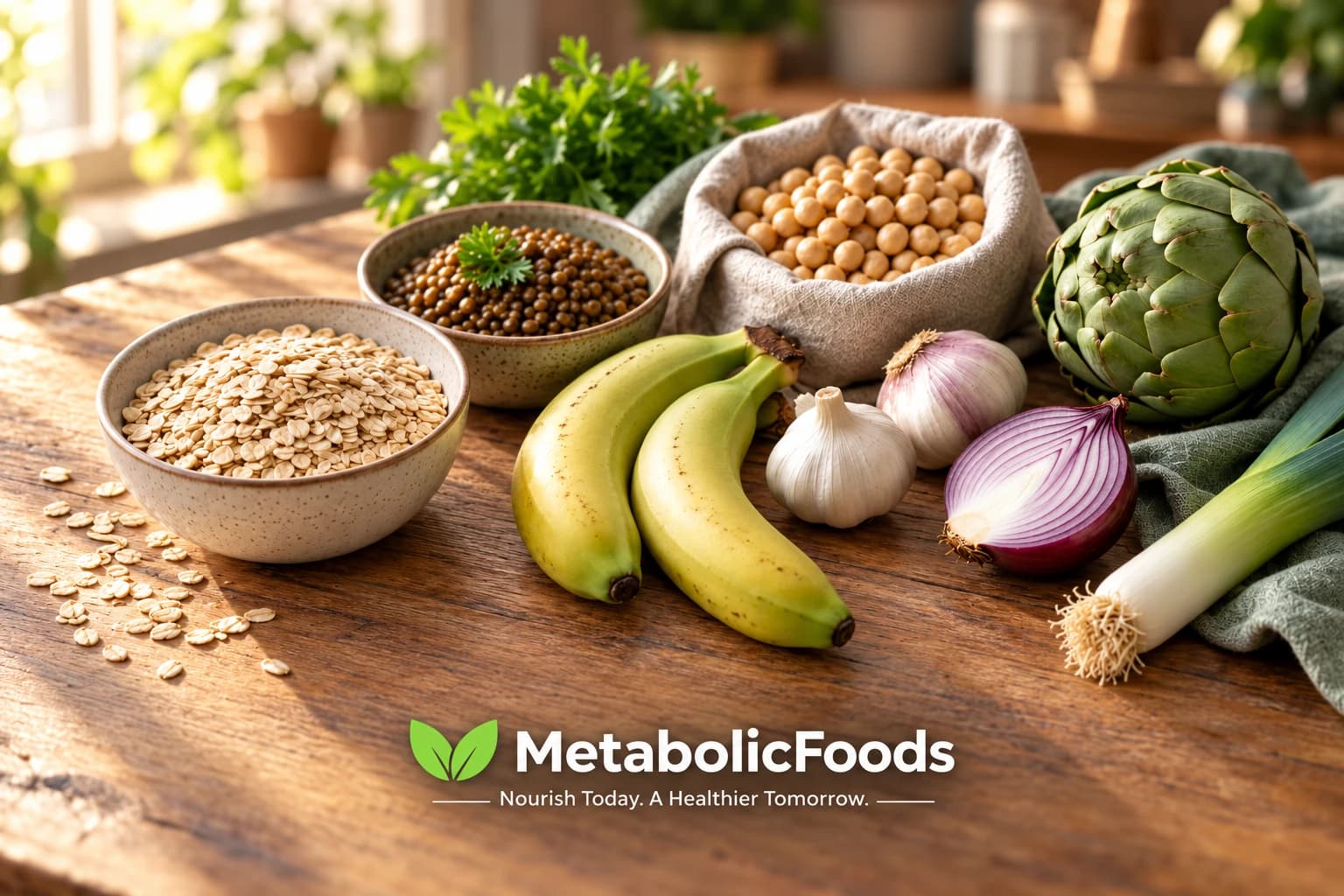
A slightly green banana, a bowl of oats, a pot of lentil soup, and a sauté that starts with garlic and onions have more in common than most grocery shoppers realize. Each contains carbohydrates that your small intestine does not fully digest, which means they travel on to the large intestine, where gut microbes can ferment them. That brings up a common question: what is prebiotic fiber, and how is it different from fiber in general?
The short answer is that a prebiotic is defined by what it does, not just by what it is. Prebiotic fiber is not a probiotic, and it is not simply another name for total dietary fiber. It is one useful part of a high-fiber eating pattern built around real foods.
What Is Prebiotic Fiber, Exactly?
The International Scientific Association for Probiotics and Prebiotics (ISAPP), the expert panel that maintains the scientific definition, describes a prebiotic as "a substrate that is selectively utilized by host microorganisms conferring a health benefit." Two conditions matter in that definition. Gut microbes have to use the compound selectively, and a health benefit has to be documented. Being fermentable is not enough on its own.
Many prebiotics are fibers, but the two terms are not interchangeable. Dietary fiber is a broad category of plant carbohydrates that are not fully digested in the small intestine. Some fibers mainly add bulk, some form thick gels in water, and some are fermented by microbes in the large intestine. The ISAPP definition also leaves room for prebiotics that are not carbohydrates at all, although the familiar examples are fiber-like carbohydrates.
Inulin-type fructans, including inulin and fructooligosaccharides, and galactooligosaccharides are among the best-studied examples. Other compounds, including some types of resistant starch, are fermented by gut microbes and are still being studied in this context.
When gut microbes ferment these carbohydrates, they produce short-chain fatty acids such as acetate, propionate, and butyrate. Researchers are actively studying how these compounds influence different processes in the body. The science is genuinely interesting, but prebiotic foods are not a cure-all, and individual responses vary.
Prebiotic Fiber vs. Probiotics vs. Total Fiber
These terms often appear together on food packages, but they describe different things. Probiotics are live microorganisms. Prebiotics are substrates that microbes use. Synbiotics, as ISAPP defines them, combine live microorganisms with a substrate that is selectively used by microbes and that together confer a health benefit. Our guide to prebiotics vs. probiotics covers those definitions in more detail.
Total fiber includes prebiotic fiber, but it also includes fibers whose main value lies elsewhere. Beta-glucan, the soluble fiber in whole oats and barley, is a good example: the FDA allows a health claim linking soluble fiber from these foods, as part of a diet low in saturated fat and cholesterol, to a reduced risk of heart disease. You can read more about how fiber types differ in our article on soluble vs. insoluble fiber.
For everyday eating, this distinction does not need to become complicated. A varied plant-forward pattern naturally provides a mix of fiber types, which is more practical than relying on one ingredient or supplement.
Why Prebiotic Foods Matter
Most Americans do not eat the recommended amount of dietary fiber. Foods that contain prebiotic carbohydrates can help close that gap, and many of them, such as beans, lentils, oats, and vegetables, bring other nutrients and plenty of flavor to a meal at the same time. If you are unsure where your intake stands, our article on how much fiber you need is a good starting point.
The type of food still matters. A sweetened snack bar with added inulin is not nutritionally equivalent to a meal of lentils, vegetables, and whole grains. Added prebiotic ingredients can be useful, but they do not replace the broader value of minimally processed plant foods.
Foods With Prebiotic Fiber
You do not need specialty products to eat more prebiotic carbohydrates. Many familiar foods supply them naturally, though the amount varies with variety, ripeness, preparation, and portion size.
- Garlic, onions, leeks, and artichokes. These vegetables are particularly rich in fructans, the family of carbohydrates that includes inulin. They are easy to add to soups, sauces, sheet-pan dinners, and omelets.
- Chicory root. Chicory root is considered the richest source of inulin, which is why chicory root fiber shows up as an added ingredient in many packaged foods.
- Beans, lentils, and chickpeas. The main fermentable carbohydrates in legumes are galactooligosaccharides, and legumes also provide substantial total fiber and plant protein. Canned beans count. Draining and rinsing them can noticeably lower their sodium.
- Wheat and other grains. Fructans are the main fermentable carbohydrates in wheat and other cereal grains. Checking the ingredient list for whole grains is more useful than relying on front-of-package claims.
- Slightly green bananas. Less ripe bananas contain starch that resists digestion in the small intestine.
- Cooked and cooled starches. Cooling cooked starchy foods can increase their resistant starch. In one controlled study, white rice that was cooked, chilled, and then reheated contained more resistant starch than freshly cooked rice.
No single food needs to carry the entire load. Variety gives different microbes different carbohydrates to work with, and it also keeps meals interesting.
How to Add Prebiotic Fiber Without Making Meals Harder
The most effective approach is gradual. If your current fiber intake is low, jumping straight to a large serving of beans, raw onions, and a fiber supplement can cause gas, bloating, and cramping. Increasing fiber slowly over a few weeks gives your digestive system time to adjust, and drinking enough fluids helps fiber move through your system.
Start by adding one food to a meal you already eat. Stir oats into yogurt, add lentils to a soup, use beans in tacos, or start a pan sauce with garlic and onions. A practical pattern is to pair a protein source with a high-fiber plant food and a satisfying fat, such as a lentil and greens bowl with roasted vegetables and tahini, or berry and chia overnight oats for breakfast. Meals like these provide more than one type of fiber without turning dinner into a nutrition project.
Should You Use a Prebiotic Fiber Supplement?
Added fibers can be convenient when food intake is limited, travel disrupts routines, or you simply want an easy way to increase fiber slowly. Inulin, chicory root fiber, and other oligosaccharides appear in powders, bars, cereals, yogurts, and lower-sugar packaged foods.
The trade-off is tolerance. How well people tolerate added fibers depends on the type and the dose, and larger amounts are more likely to cause gas and bloating. A product with a high fiber number is not automatically a better choice if it leaves you uncomfortable or displaces more nourishing foods. Review the ingredient list, begin with a small serving, and consider the product's added sugar, protein, and sodium as well. If you notice extra gas as you add fiber, our article on whether resistant starch causes gas explains why fermentation can have that effect.
When to Be More Careful
People with irritable bowel syndrome (IBS) may find that certain fermentable carbohydrates trigger symptoms. Fructans in garlic, onions, and wheat, and galactooligosaccharides in legumes, are all high-FODMAP, which is why they are limited during a low-FODMAP approach. That does not make these foods unhealthy. It means personal tolerance matters, and a low-FODMAP diet is best followed with guidance from a healthcare professional.
If digestive symptoms are persistent, severe, or new, talk with a qualified healthcare professional or registered dietitian rather than trying to solve the problem by eliminating broad food groups. Nutrition guidance can support everyday choices, but it is not a substitute for medical care.
Prebiotic fiber works best as part of a pattern, not as a single ingredient to chase. Build from foods you enjoy and can eat consistently, increase them at a comfortable pace, and let your grocery cart reflect the kind of gut-friendly eating that is realistic for your life.
Sources
- Effect of cooling of cooked white rice on resistant starch content and glycemic responseAsia Pacific Journal of Clinical NutritionJanuary 1, 2015Verified
- 21 CFR 101.81 — Health claims: Soluble fiber from certain foods and risk of coronary heart diseaseU.S. Food and Drug Administration (Code of Federal Regulations)Verified
- Short-chain fatty acids and human colonic function: roles of resistant starch and nonstarch polysaccharidesPhysiological ReviewsJuly 1, 2001Verified
- High and low FODMAP foodsMonash University FODMAPVerified
- From Dietary Fiber to Host Physiology: Short-Chain Fatty Acids as Key Bacterial MetabolitesCellJune 2, 2016Verified
- Fiber (MedlinePlus Medical Encyclopedia)MedlinePlus, U.S. National Library of MedicineVerified
- The International Scientific Association for Probiotics and Prebiotics (ISAPP) consensus statement on the definition and scope of synbioticsNature Reviews Gastroenterology & HepatologyAugust 21, 2020Verified
- Expert consensus document: The International Scientific Association for Probiotics and Prebiotics (ISAPP) consensus statement on the definition and scope of prebioticsNature Reviews Gastroenterology & HepatologyJune 14, 2017Verified
- How to Reduce Sodium in Your DietAmerican Heart AssociationVerified
- Inulin: Properties, health benefits and food applicationsCarbohydrate PolymersApril 8, 2016Verified
- Gastrointestinal Effects and Tolerance of Nondigestible Carbohydrate ConsumptionAdvances in NutritionDecember 22, 2022Verified
- Beyond Insoluble Dietary Fiber: Bioactive Compounds in Plant FoodsNutrientsSeptember 25, 2023Verified
- Digestion of the carbohydrates of banana (Musa paradisiaca sapientum) in the human small intestineAmerican Journal of Clinical NutritionJuly 1, 1986Verified
- Closing America's Fiber Intake Gap: Communication Strategies From a Food and Fiber SummitAmerican Journal of Lifestyle MedicineJuly 7, 2016Verified
- Eating, Diet, & Nutrition for Irritable Bowel SyndromeNational Institute of Diabetes and Digestive and Kidney Diseases (NIH)Verified
Continue reading

Does Resistant Starch Cause Gas? What to Know
Resistant starch can cause gas, especially when you add it quickly. Here is why it happens, why some foods feel harder to tolerate, and how to increase it more comfortably.
Prebiotics vs. Probiotics: What's the Difference?
The two words are easy to mix up. Here are the formal, expert-consensus definitions of each, and how fermented foods fit alongside both.
Do Fermented Foods Really Help Gut Health?
Fermented foods are sold with confident promises. A 2025 review of 19 randomized trials points to real signals for everyday digestion — and rates the evidence as mostly low certainty. Here is the honest version.