Does Resistant Starch Cause Gas? What to Know
Resistant starch can cause gas, especially when you add it quickly. Here is why it happens, why some foods feel harder to tolerate, and how to increase it more comfortably.
By MetabolicFoods Editorial Team

A bowl of cooled potato salad or a serving of beans can offer more than fiber. These foods can contain resistant starch, a carbohydrate that reaches the large intestine largely undigested, where gut microbes ferment it. But does resistant starch cause gas? It can, especially when you increase your intake quickly. That does not mean resistant starch is a problem or that you need to avoid it. Often it means your gut is adjusting to more fermentable carbohydrate.
For most people, the practical answer is to start with a small serving, keep the rest of your diet steady, and increase gradually. The goal is not to eat as much resistant starch as possible. It is to find an amount that fits your eating pattern and feels comfortable.
Does resistant starch cause gas?
Yes, resistant starch can cause gas or bloating in some people. These effects happen because resistant starch resists digestion in the small intestine. When it reaches the colon, gut bacteria ferment it.
Fermentation produces short-chain fatty acids, including butyrate, a preferred energy source for the cells lining the colon. It also produces gases, mainly hydrogen and carbon dioxide, and in some people part of that hydrogen is converted to methane by gut microbes. Some gas is a normal part of digestion. Symptoms arise when the amount of gas, gut sensitivity, or the way gas moves through the digestive tract goes beyond your comfort level.
The response varies widely. Research on nondigestible carbohydrates, the broad group that includes resistant starch, shows that tolerance depends on the specific type and the dose. One person may add beans or less-ripe bananas without noticing much difference. Another may feel bloated after a smaller increase. Your usual fiber intake, your gut microbes, meal size, and digestive sensitivity all matter. For a closer look at daily fiber needs, see our guide How Much Fiber Do You Really Need?
Why some resistant starch foods feel harder to tolerate
Resistant starch is not one single ingredient. It is a category of starches that escape digestion for different reasons. Some forms occur naturally in foods, while others form when cooked starchy foods are cooled. Our article What Is Resistant Starch? covers the different types.
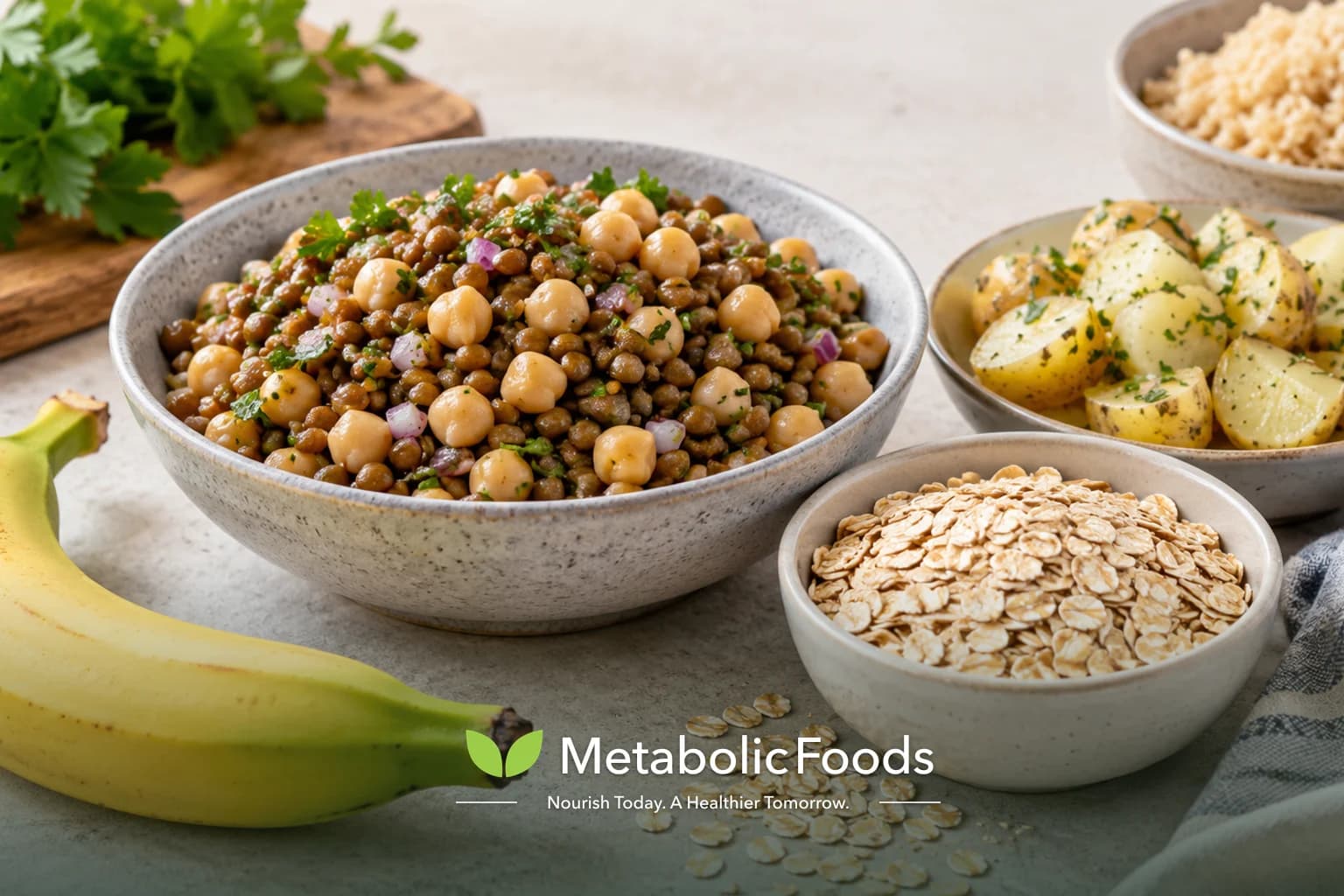
Legumes and less-ripe bananas contain naturally occurring resistant starch. Cooked and cooled potatoes, rice, and pasta can develop more resistant starch through a process called retrogradation. In one small study, rice that was cooled and then reheated still had more resistant starch than freshly cooked rice, so reheating does not necessarily undo the effect.
The food itself matters as much as the resistant starch. Beans and lentils also contain oligosaccharides, other fermentable carbohydrates that can contribute to gas. A serving of chickpeas may be challenging for someone who is sensitive to several components of legumes, not resistant starch alone. Likewise, a cold potato salad may include onion, garlic, a rich dressing, or a large portion size, each of which can affect digestion.
This distinction is useful when you are trying to identify a trigger. If lentils cause symptoms but cooled rice does not, the issue may not be resistant starch broadly. If symptoms show up after any major fiber increase, the total amount of fermentable carbohydrate may be the more relevant factor.
Your baseline fiber intake changes the experience
Eating a large amount of fiber in a short time can cause gas, bloating, and cramps, and the volume of gas the colon produces tends to rise with fiber intake. People who usually eat a low-fiber diet may notice this most when they suddenly add several high-fiber, resistant-starch-rich foods. This discomfort often eases as gut bacteria adjust, but that adjustment is not immediate.
Adding a large portion of beans, a green banana smoothie, and a fiber supplement in the same week creates a lot of variables. It can also create more gas than is comfortable. A slower approach makes it easier to identify what works.
IBS and gut sensitivity can complicate the picture
People with irritable bowel syndrome (IBS), frequent bloating, or known sensitivity to fermentable carbohydrates may react more strongly. For people with IBS, too much fiber at once can cause gas that triggers symptoms. Resistant starch is not automatically off-limits in these situations, but the type, dose, and meal context become more important.
A food can be nutritionally valuable and still be a poor fit for you at a certain serving size. If gas symptoms bother you, change suddenly, or come with abdominal pain, constipation, diarrhea, or weight loss, see a healthcare professional rather than troubleshooting with dietary experiments alone.
How to add resistant starch with less gas
The most effective strategy is gradual exposure. Rather than making several major changes at once, choose one resistant-starch-containing food and try a modest portion for several days.
For example, add a half cup of lentils to a grain bowl instead of building a meal around two cups of beans. Try a small serving of cooled potatoes alongside salmon and vegetables, rather than a large potato salad at a cookout. If you are adding other fiber at the same time, avoid stacking multiple added fibers, such as inulin, chicory root fiber, or large amounts of bran.
Give each change time. MedlinePlus advises adding fiber gradually over a few weeks, and for people with IBS, the National Institute of Diabetes and Digestive and Kidney Diseases suggests increasing fiber by about 2 to 3 grams a day. Keep portions consistent before increasing them. This is more useful than eliminating every food that causes a little gas once.
Meal composition can help, too. Pair resistant starch foods with familiar proteins and vegetables rather than introducing several new high-fiber foods at once. Eat at a comfortable pace. Drinking enough fluids helps fiber move through the digestive system, although extra water alone will not prevent fermentation-related gas.
If legumes are the issue, canned beans that are drained and rinsed, or dried beans that are boiled and drained, tend to be lower in some fermentable carbohydrates, because part of them leaches into the liquid. Starting with a small portion of lentils can also be practical. The best choice is the one you can eat consistently without turning every meal into a digestive experiment.
Resistant starch supplements deserve extra caution
Powders made from green banana flour, raw potato starch, or high-amylose corn starch can deliver a concentrated dose quickly. They may be convenient, but because tolerance is dose-dependent, a full scoop is more likely to cause gas than a gradual start.
Whole foods provide resistant starch alongside protein, vitamins, minerals, and other forms of fiber. They also make portion control more intuitive. Foods such as beans, lentils, cooked-and-cooled potatoes or grains, and less-ripe bananas can be a practical starting point.
If you choose a supplement, begin below the suggested serving size and change only one digestive variable at a time. A supplement is not inherently better than food, and more is not necessarily better.
A practical way to find your comfortable amount
Think in servings, not perfection. You might begin with one of these options: a half cup of cooked lentils, a small side of cooled potatoes, or slightly green banana slices added to yogurt. Keep that choice in your routine for several days and pay attention to bloating, stool changes, and overall comfort.
If you feel well, increase the portion slowly or rotate in another source. If you develop bothersome gas, reduce the serving instead of abandoning the food entirely. Tolerance often depends on dose. A half cup may work well even when a full cup does not.
It also helps to look at your full day of eating. A lunch with beans and a dinner built around cooled rice can be part of a high-fiber pattern, but adding both at once may be too abrupt for someone transitioning from refined grains and lower-fiber meals. Spacing these foods across the week can be a more sustainable way to build tolerance.
Gas is feedback, not a verdict
Some extra gas after increasing resistant starch is common and often eases as your gut adjusts. Painful bloating, major disruption to your day, or symptoms that do not improve are different signals. In those cases, scale back, simplify your meals, and consider discussing ongoing symptoms with a qualified healthcare professional or registered dietitian.
Resistant starch can be a useful part of real-food eating, but it is not something you need to force. Start with foods you enjoy, use portions your digestion can handle, and let comfort guide the pace of change.
Sources
- Effect of cooling of cooked white rice on resistant starch content and glycemic responseAsia Pacific Journal of Clinical NutritionJanuary 1, 2015Verified
- New definition of resistant starch types from the gut microbiota perspectives - a reviewCritical Reviews in Food Science and NutritionJanuary 25, 2022Verified
- Short-chain fatty acids and human colonic function: roles of resistant starch and nonstarch polysaccharidesPhysiological ReviewsJuly 1, 2001Verified
- Mechanisms of microbial hydrogen disposal in the human colon and implications for health and diseaseAnnual Review of Food Science and TechnologyJanuary 1, 2010Verified
- Meta-Analysis of the Composition of Human Intestinal GasesDigestive Diseases and SciencesOctober 8, 2021Verified
- Fiber (MedlinePlus Medical Encyclopedia)MedlinePlus, U.S. National Library of MedicineVerified
- Symptoms & Causes of Gas in the Digestive TractNational Institute of Diabetes and Digestive and Kidney Diseases (NIH)Verified
- Gastrointestinal Effects and Tolerance of Nondigestible Carbohydrate ConsumptionAdvances in NutritionDecember 22, 2022Verified
- Legumes and PulsesHarvard T.H. Chan School of Public Health, The Nutrition SourceVerified
- Including legumes on a low FODMAP dietMonash University FODMAPVerified
- Digestion of the carbohydrates of banana (Musa paradisiaca sapientum) in the human small intestineAmerican Journal of Clinical NutritionJuly 1, 1986Verified
- Eating, Diet, & Nutrition for Irritable Bowel SyndromeNational Institute of Diabetes and Digestive and Kidney Diseases (NIH)Verified
Continue reading

Prebiotics vs. Probiotics: What's the Difference?
The two words are easy to mix up. Here are the formal, expert-consensus definitions of each, and how fermented foods fit alongside both.

Do Fermented Foods Really Help Gut Health?
Fermented foods are sold with confident promises. A 2025 review of 19 randomized trials points to real signals for everyday digestion — and rates the evidence as mostly low certainty. Here is the honest version.
High-Fiber Foods With Resistant Starch: What to Eat and Why
Discover high-fiber foods with resistant starch, how cooking and cooling affect starch, and simple ways to add more fiber to everyday meals.