What Are Functional Foods, Really?
"Functional food" appears on packaging with a confidence the term hasn't earned. Here is how researchers use it, why it is not an FDA category, and what the label claims behind it actually mean.
By MetabolicFoods Editorial Team
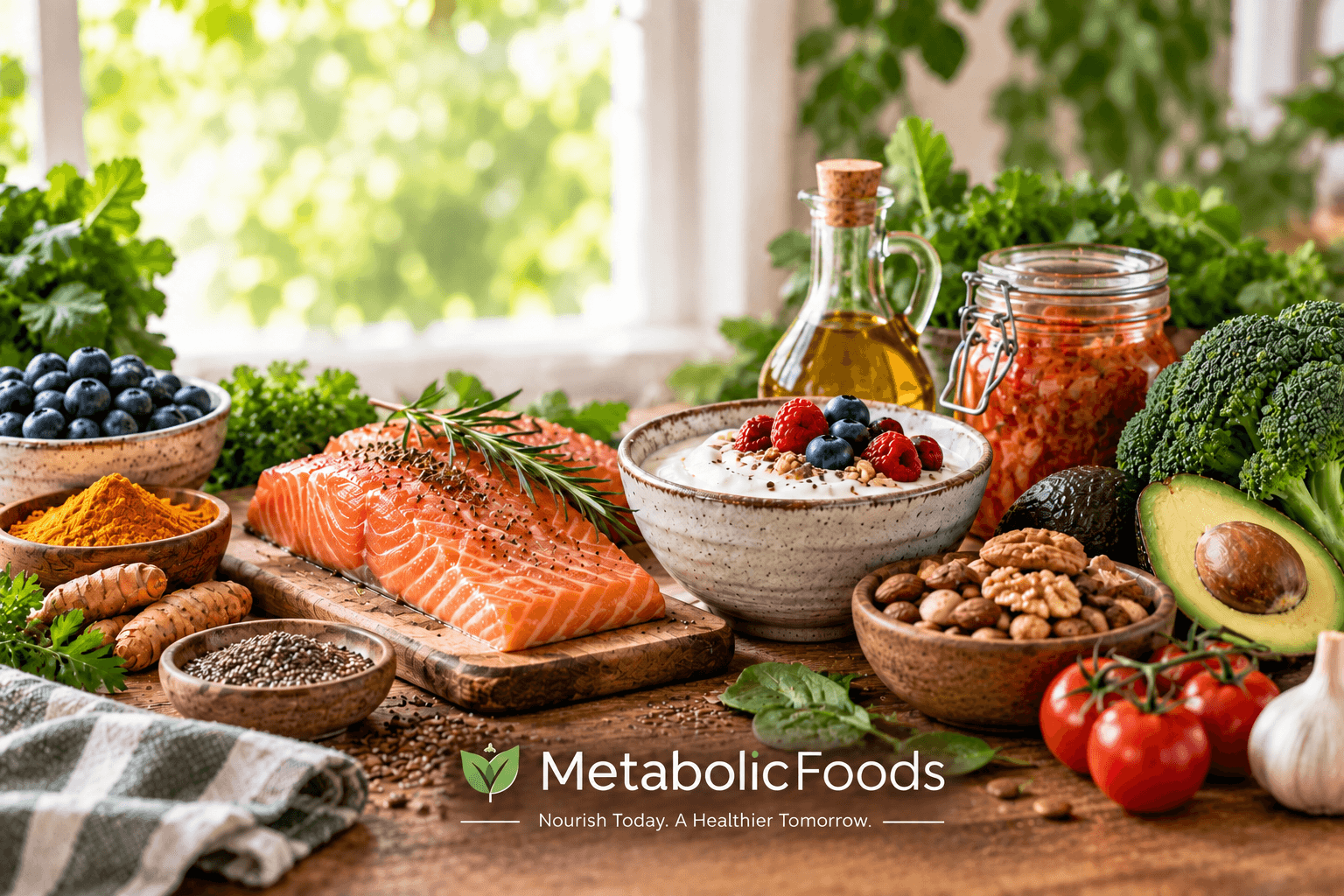
"Functional food" is one of those phrases that sounds official. It appears on packaging, in marketing, and in a good deal of nutrition writing, usually with the air of a settled category, something a product either is or is not. The reality is more interesting and, for a shopper, more useful to understand. The term has a real life in nutrition research. It does not have the regulatory life that its packaging often implies. This article separates the two.
How nutrition research uses the term
In the nutrition literature, "functional foods" are commonly described as foods that provide a health benefit beyond their basic nutrient content. That is the working description used in a 2009 review by Ferguson in the Journal of the American Dietetic Association, and it captures how the phrase tends to be used by researchers: as a way of talking about foods studied for effects that go beyond basic nutrition.
It is important to be precise about what kind of description that is. It is a working definition used in research and discussion. It is not a legal definition, and it does not come with a test a product must pass. A researcher may reasonably call a food "functional" in a paper; that says nothing about how the product is treated by regulators, and it is not an endorsement by anyone other than the author.
What the FDA does, and does not, do
Here is the point that most surprises people. "Functional food" is not a standalone FDA regulatory product category. The agency said as much in a 2006 Federal Register notice on conventional foods being marketed as "functional foods." Current FDA guidance regulates products and claims through existing legal categories; it does not establish a separate "functional food" regulatory category.
What exists instead is the ordinary legal framework. A product is regulated under the legal category that actually applies to it, based on the product and its intended use and claims. Depending on those, something sold as a "functional food" may be regulated as a conventional food, as a dietary supplement, or as a drug. The word on the front of the package does not choose the category; the product and its claims do.
It follows that the FDA does not define or endorse a scientific definition of "functional food." The agency regulates products and the statements made about them. There is no FDA "functional food" status for a product to carry.
Three kinds of claims
If the category is not real, the claims are. The FDA separately regulates three kinds of label claims: health claims, nutrient content claims, and structure/function claims. Much of what people mean when they call a food "functional" is really one of these three, dressed in a more general word.
Structure/function claims deserve particular attention, because they are handled differently depending on the product. For dietary supplements, a company making a structure/function claim must notify the FDA within 30 days of first marketing the product with that claim, and the label must carry a mandatory disclaimer. For conventional foods, no notification and no disclaimer are required, and the claim must derive from the food's nutritive value. The same style of statement, in other words, sits under different rules depending on what kind of product is making it.
Reading a label with this in mind
None of this is a reason for cynicism. It is a reason for a clearer set of questions.
The first question is what kind of product you are holding: a conventional food, a supplement, or something else. The second is what kind of statement it is making, and whether that statement is a specific, regulated claim or a general word like "functional" that carries no regulatory meaning of its own. The third, and the one that matters most, is what evidence sits behind the statement, and of what kind.
That third question is where this site tries to help, by showing the evidence rather than the label.
What "beyond basic nutrition" can look like when it is sourced
To make the research description concrete, it helps to look at foods where the evidence has actually been gathered, using the same sources we cite elsewhere on this site.
Fiber is one example. A 2019 systematic review and meta-analysis in The Lancet found that, comparing the highest to the lowest fiber consumers, observational research showed associations with lower rates of all-cause and cardiovascular mortality, coronary heart disease, stroke, type 2 diabetes, and colorectal cancer, with the greatest risk reduction associated with daily intakes of roughly 25 to 29 grams. In clinical trials, higher fiber intake was linked to modest reductions in body weight, blood pressure, and total cholesterol.
Protein is another. A 2020 systematic review and meta-analysis of randomized controlled trials found protein intake reduced hunger and increased fullness in the hours after eating, alongside changes in appetite-related hormones.
Fermented foods are a third, and a good illustration of holding the evidence honestly. A 2025 systematic review and meta-analysis pooling 19 randomized controlled trials in 4,328 healthy adults found fermented food consumption was associated with more frequent bowel movements, improved stool consistency, lower gastrointestinal symptom scores, and shorter intestinal transit time. The same review rated the certainty of that evidence as highly variable and mostly low.
Notice what those three examples have in common. In each case the interesting part is not the word "functional." It is the specific finding, the type of study it came from, and how confident the researchers were in it. That is the standard worth applying to any product that reaches for the term.
The short version
"Functional food" is a real and reasonable phrase in nutrition research, where it describes foods studied for benefits beyond basic nutrition. It is not an FDA category, and the FDA neither defines nor endorses it; products are regulated as conventional foods, dietary supplements, or drugs according to what they are and what they claim, and the claims themselves fall into three separately regulated types. When you see the term on a package, look past it to the specific claim and the evidence behind it. The Functional Foods category on this site is where we gather foods and reading that meet that standard.
Sources
- Nutrigenomics approaches to functional foodsJournal of the American Dietetic AssociationVerified
- Conventional Foods Being Marketed as "Functional Foods"; Public Hearing; Request for CommentsU.S. Food and Drug Administration (Federal Register)October 25, 2006Verified
- Carbohydrate quality and human health: a series of systematic reviews and meta-analysesThe LancetJanuary 10, 2019Verified
- Structure/Function ClaimsU.S. Food and Drug AdministrationVerified
- Effect of short- and long-term protein consumption on appetite and appetite-regulating gastrointestinal hormones, a systematic review and meta-analysis of randomized controlled trialsPhysiology & BehaviorAugust 5, 2020Verified
- Label Claims for Conventional Foods and Dietary SupplementsU.S. Food and Drug AdministrationVerified
- Impact of fermented foods consumption on gastrointestinal wellbeing in healthy adults: a systematic review and meta-analysisFrontiers in NutritionOctober 10, 2025Verified
Continue reading

What Is Resistant Starch? Foods, Benefits, and How It Works
Resistant starch is the portion of starch that skips digestion in the small intestine. Here is how it is classified, what the research links to it, and where it shows up in ordinary food.

How to Build a Lower-Glycemic Meal
Glycemic index describes individual foods. Here is what the research says about how combining and sequencing foods within a meal changes the outcome.

Prebiotics vs. Probiotics: What's the Difference?
The two words are easy to mix up. Here are the formal, expert-consensus definitions of each, and how fermented foods fit alongside both.