Low-Glycemic Snacks: 10 Satisfying Ideas
Build low-glycemic snacks with practical combinations of fruit, vegetables, legumes, dairy or soy foods, nuts, seeds, and intact grains.
By MetabolicFoods Editorial Team
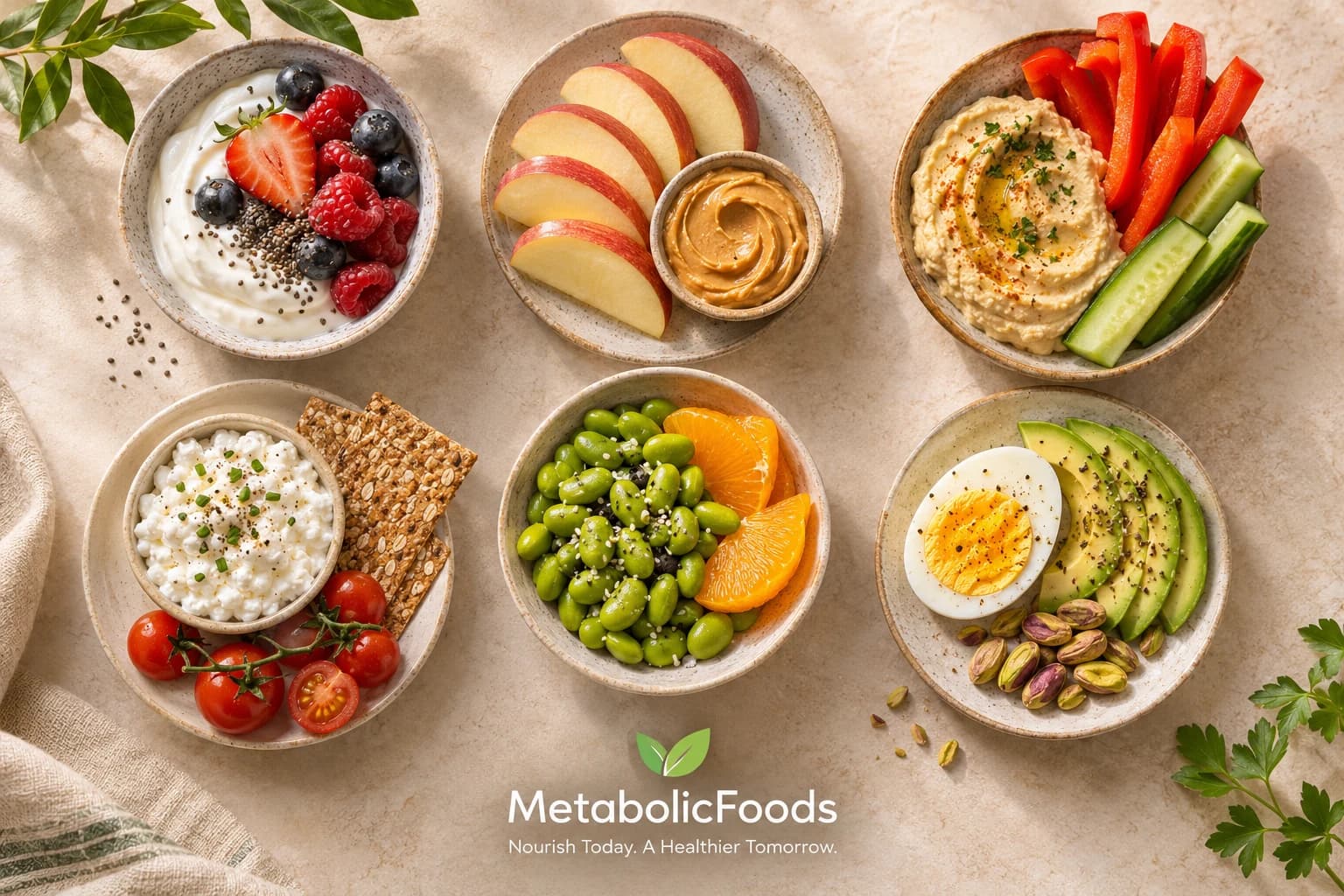
A snack can carry a health claim and still be too small—or too lightly built—to bridge the gap to your next meal. Low-glycemic snacks are not one perfect list of foods. They are small eating occasions that consider the carbohydrate source, portion, food structure, and the rest of the snack.
Fruit, plain yogurt, legumes, nuts, seeds, vegetables, and selected intact grains can all contribute. The goal is not to eliminate carbohydrate or promise a flat glucose line. It is to build a snack that fits your hunger, schedule, and individual nutrition needs.
What Makes a Snack Low Glycemic?
The glycemic index, or GI, ranks carbohydrate-containing foods according to their blood-glucose response compared with a reference food, usually glucose. On the glucose scale, a GI of 55 or less is generally classified as low, 56 to 69 as medium, and 70 or above as high.
GI testing uses a fixed amount of available carbohydrate under standardized conditions. A normal snack may contain less carbohydrate than the test portion, and many snack foods—such as eggs, tuna, cheese, oils, and most non-starchy vegetables—do not contain enough available carbohydrate for a meaningful GI value.
Glycemic load adds the available carbohydrate in the serving to the calculation. This makes portion part of the discussion, but neither GI nor GL tells you whether a snack is high in protein, fiber, sodium, saturated fat, or overall nutritional value.
Preparation and processing matter too. Published GI values vary across fruit varieties, oat formats, breads, crackers, and other manufactured foods. Use a reliable value for the specific food when available rather than borrowing a number from a vaguely similar product.
A Practical Formula: Carbohydrate Plus a Companion
Start with a carbohydrate-containing food that commonly tests in the low-GI range or provides a modest amount of available carbohydrate: whole fruit, legumes, plain dairy, unsweetened soy foods, or a product with an intact grain structure.
Then add a companion when the snack needs more staying power. That might be Greek yogurt, cottage cheese, eggs, edamame, tuna, nuts, seeds, nut butter, hummus, or avocado.
Controlled trials suggest that higher-protein eating occasions can increase short-term fullness, although the size and duration of the effect vary. Protein, fat, and fiber can also change the glucose response to a mixed eating occasion, but no pairing makes carbohydrate disappear or guarantees the same result for every person.
There is no universal protein or calorie target for a snack. A small snack before a short walk has a different job from one that must cover a long commute. Let hunger, timing, activity, medications, and the rest of the day guide the amount.
10 Low-Glycemic Snack Ideas
These combinations are starting points. Adjust portions for appetite, allergies, culture, budget, and medical needs.
1. Plain Greek Yogurt With Berries and Chia
Plain Greek yogurt contributes protein, while berries and chia add fiber and texture. Choose unsweetened yogurt and fresh or plain frozen berries. Flavored yogurts vary widely, so compare added sugars and serving sizes rather than assuming every “Greek” product is similar.
2. Apple or Pear With Nut Butter
Apples and pears commonly fall in the low-GI range. Pair slices with peanut or almond butter when fruit alone is not substantial enough. Use an amount of nut butter that matches your hunger rather than treating the jar’s serving size as a prescription.
3. Hummus With Crunchy Vegetables
Hummus combines chickpeas with tahini or another fat source, while bell pepper, cucumber, carrots, and snap peas add crunch and volume. Protein and fiber depend on the hummus brand and portion; add edamame or an egg when you need something more substantial.
4. Cottage Cheese With Tomatoes and Crispbread
Cottage cheese can provide a convenient protein base. Add cherry tomatoes, pepper, herbs, and one or two pieces of dense whole-grain crispbread. Bread and cracker GI values vary, so “whole grain” alone is not proof that a product is low GI. Compare fiber, serving size, sodium, and ingredients.
5. Shelled Edamame With a Piece of Fruit
Edamame provides plant protein and fiber. Pair it with citrus, berries, an apple, or another whole fruit you enjoy. Frozen edamame is convenient; prepare it according to the package and refrigerate leftovers promptly.
6. Roasted Chickpeas With Raw Vegetables
Legumes are among the carbohydrate foods that most consistently appear in the low-GI range in the international tables. Roasted chickpeas are portable, but flavored versions can be salty. Compare sodium between similar products and use vegetables or fruit to round out the snack.
7. Egg, Avocado, and Dense Whole-Grain Toast
Egg and avocado do not need a GI label to be useful: egg contains little carbohydrate, while avocado contributes mostly fat and fiber. Add a modest slice of dense whole-grain toast if the snack needs carbohydrate. Product structure matters, so a finely milled bread and an intact, dense bread may not produce the same response.
8. Tuna or Salmon With Seeded Crackers
Mix tuna or salmon with plain yogurt, avocado, or a modest amount of mayonnaise and serve it with cucumber and seeded crackers. Check sodium across canned fish and crackers, especially when both appear in the same snack.
9. Overnight Oats With Yogurt and Seeds
Combine rolled oats with plain Greek yogurt or unsweetened soy yogurt, chia or ground flax, and a small portion of berries. Oat products do not have interchangeable GI values: processing and particle size matter, and instant oatmeal can respond differently from less-processed oat formats.
10. Pistachios or Walnuts With Whole Fruit
Nuts provide fat, some protein, and fiber, while whole fruit provides carbohydrate, water, and additional fiber. A defined portion can be useful for portability, but there is no need to treat a larger appetite as a failure. Add yogurt, cheese, or edamame when the snack needs to do more work.
How to Evaluate Packaged Snacks
Words such as “protein,” “keto,” “natural,” “no refined sugar,” and “made with whole grains” do not describe the whole product. Start with the Nutrition Facts serving size and compare it with the amount you would realistically eat. If the package contains two servings and you normally eat both, use both servings when comparing nutrients.
Then look at total carbohydrate, fiber, added sugars, protein, sodium, and saturated fat in context. A snack with meaningful protein and fiber may be more substantial than one built mostly from refined starch and syrup, but the label cannot predict individual fullness or glucose response.
Read the ingredient list to understand the product’s base. Nuts, seeds, oats, legumes, and dairy or soy proteins can make a useful foundation. Isolated fibers can also contribute to the fiber line; some people tolerate them well, while others notice digestive symptoms.
Sugar alcohols may reduce the sugar listed in bars and candies, but they do not all behave identically. The FDA notes that sugar alcohols may be listed under total carbohydrate, and some can cause gas, bloating, or diarrhea in susceptible people. Compare the full label and notice your own tolerance rather than relying only on a “net carb” claim.
Common Mistakes With Low-Glycemic Snacks
One mistake is treating “low GI” as a synonym for low calorie, low carbohydrate, or automatically nutritious. Those are separate characteristics.
Another is assuming every whole-grain cracker, granola, or oat bar is low GI. Milling, extrusion, added sugars, and product structure can change the response. A product-specific value is more useful than a category-wide promise.
A third is treating smoothies, trail mix, and dried fruit as unlimited because their ingredients are familiar. These foods can fit, but liquid and compact formats are easy to consume quickly. Portion them according to the job the snack needs to do.
Finally, low glycemic does not need to mean very low carbohydrate. Beans, lentils, whole fruit, plain yogurt, and selected intact grains provide carbohydrate alongside other nutrients. Current American Diabetes Association guidance emphasizes individualized meal plans and minimally processed, nutrient-dense, high-fiber carbohydrate sources rather than one universal macronutrient split.
Make the Useful Choice Easy to Reach
Keep a short rotation rather than an enormous approved-food list: one fruit-and-protein option, one vegetable-and-legume option, one refrigerator snack, and one shelf-stable backup. Wash durable produce, portion nuts when that improves convenience, and keep frozen edamame or berries available.
You also do not need to snack simply because the clock says so. If regular meals meet your needs and you are not hungry, a snack is optional.
If you monitor glucose closely, use insulin or another glucose-lowering medicine, or have a condition that changes your nutrition needs, a registered dietitian or qualified clinician can help tailor snack carbohydrate, timing, and portions. For everyday planning, focus on the whole snack, use GI as context, and choose combinations you can genuinely repeat.
Sources
- International tables of glycemic index and glycemic load values 2021: a systematic reviewThe American Journal of Clinical NutritionJuly 13, 2021Verified
- Added Sugars on the Nutrition Facts LabelU.S. Food and Drug AdministrationVerified
- How to Understand and Use the Nutrition Facts LabelU.S. Food and Drug AdministrationVerified
- Interactive Nutrition Facts Label — Sugar AlcoholsU.S. Food and Drug AdministrationOctober 1, 2021Verified
- About Glycemic IndexUniversity of Sydney, Glycemic Index Research and GI DatabaseVerified
- Effect of short- and long-term protein consumption on appetite and appetite-regulating gastrointestinal hormones, a systematic review and meta-analysis of randomized controlled trialsPhysiology & BehaviorAugust 5, 2020Verified
- Facilitating Positive Health Behaviors and Well-being to Improve Health Outcomes: Standards of Care in Diabetes—2026Diabetes CareVerified
- Mixed meal ingestion diminishes glucose excursion in comparison with glucose ingestion via several adaptive mechanisms in people with and without type 2 diabetesDiabetes, Obesity and MetabolismVerified
Continue reading
Is Oatmeal Low Glycemic? It Depends on the Oats
Oatmeal can be low or moderate glycemic depending on the oat format, processing, portion, and complete meal. Learn how steel-cut, rolled, and instant oats differ.
12 Low-Glycemic Breakfast Ideas for Real Mornings
Build a lower-glycemic breakfast with 12 practical ideas featuring yogurt, oats, beans, lentils, eggs, tofu, fruit, nuts, seeds, and vegetables.
Low-Glycemic Fruits: A Practical Guide to Whole Fruit
Discover which whole fruits commonly fall in the low-GI range, why portions and fruit form matter, and how to build satisfying fruit snacks and meals.